

Time saved but not spent
AI is giving companies back thousands of hours. Almost nobody has decided what to do with them.
Tuesday, November 3, 2026
When I ask leaders how their AI rollout went, the honest answer is usually some version of “hard to say.”
People are using the tools. There’s a real feeling around the office that time is being saved and work is moving faster, but nobody can point to where the time went.
Nearly every large client we work with is in the middle of an AI push right now. Let me describe one. They rolled out an approved list of tools, made them mandatory, and trained everyone on how each tool works. What nobody did was tell people why, which kinds of work the tools fit, or what good use looks like. Tool access, no strategy. I’m describing one company, but I could be describing most of them.
 So the gains are landing one team at a time.
In one group, Copilot drafts the first pass of documents, Zoom captures and summarizes the meetings, and Airtable AI structures what used to take a spreadsheet. Their turnaround is visibly shorter.
Around the corner, people with the same licenses are building spreadsheets cell by cell, writing up meeting notes and assignments by hand, and digging through documents in Box that could have been summarized for them.
Nobody is resisting, but nothing is changing because no one showed them where the new tools fit. Nothing in the rollout connects one team’s wins to the next, so what one group figures out isn’t being shared with, and can’t be learned by, the rest of the organization.
 Our partners at Miro recently published a piece on their Up for Renewal Substack, Fast, Misaligned and Expensive. It’s spot on, and worth the read. They argue that the value AI creates is real. It’s created one person at a time, and it’s lost in the exchange between one person and the next.
We agree. And we see a second, simpler problem: much of the time AI saves never gets claimed. No one counts it, no one decides what it’s for, so it disappears. That makes it an investment problem, and a human one. Companies are buying the tools and then cutting the jobs around them, instead of reshaping those jobs for the era we’re actually in.
Let’s run a hypothetical and follow the hours. Say a team saves a hundred hours this quarter. Those hours land in one of four places.
These take a decision!
1.
More output.
Sometimes that’s more of what customers want. Often it’s more of what nobody asked for.
2.
Better work.
The same deliverable, with time to think it through.
3.
Money you didn’t spend.
The hire you didn’t make, or the vendor you didn’t bring in.
4.
Nothing.
The hours leaked into waiting, rework, and the next meeting.
What do we make more of?
Which deliverables?
Which hire?
The default—no decision needed
Here’s what I’d draw over that list if we were in a room together. Circle the first three. None of them happens unless somebody decides, ahead of time, where the hours go, who owns them, and how you’ll know it worked. More output takes a decision about what to make more of. Better work requires deciding which deliverables get the extra thinking. Money not spent takes a decision about which hire or vendor you can now skip.
Then circle the fourth on its own, because it’s a different kind of thing. Nothing needs no decision at all. It’s what happens when nobody makes one. The hours get absorbed by the waiting, the rework, and the next meeting, and by the end of the quarter nobody can say they were ever there.
That decision, assigning saved time to something specific, is the step most companies skip.
 In a Forrester study this summer, 35% of organizations said they collect no quantified AI metrics at all, and another 10% don’t track AI outcomes in any form. Nearly half of companies have no idea what their AI investment is doing. Those numbers look low to me. Across the organizations we work with, a company that can show where its saved time went is the exception. Either way, the technology has nothing to do with it. Saved time on its own is just time. Somebody has to decide what to spend it on before it counts for anything.
Where the time should go
The time these new tools give back should go to the work only people can do: deciding what matters, judging quality, and building trust across a team. Automation will take over anything with rules you can write down, and keep getting better at it. What’s left is the work you can’t write down, and it’s where the saved hours belong.
Most people don’t like being told what to do and how to do it. A mandatory tool list is exactly that. It arrives from above, with training on the buttons and nothing about the work, and people respond the way people always do. They comply on the surface and keep doing the job the way they know.
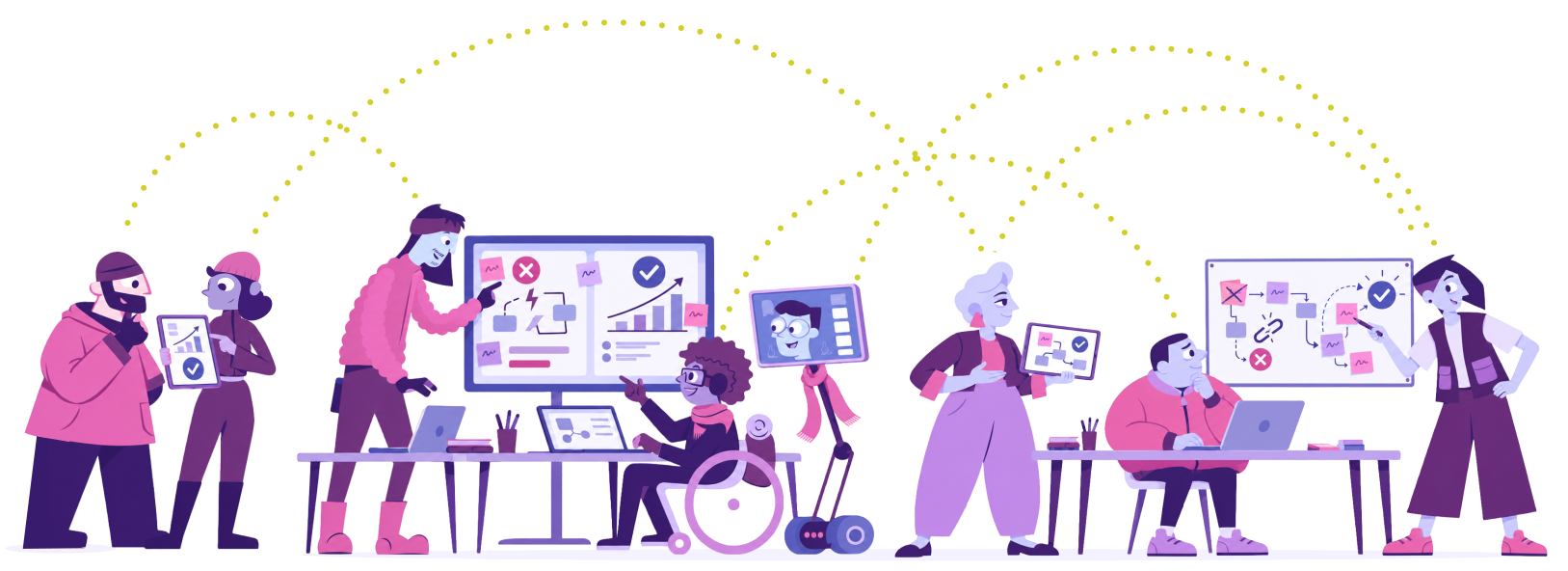
People believe in what they help to build. When a team sorts its own work, decides which pieces the tools should take and which stay with people, and puts a name next to each, the plan is theirs. They defend it, improve it, and teach it to the next team.
A tools rollout without an integrated team plan gets you the first and never the second. All it reinforces is individual contribution, and individual contribution is exactly where the hours are leaking.
Most companies have a vague sense that AI is saving time somewhere. Almost none have said, out loud, which work, how much, and whose. Until someone names it, the time stays unclaimed. Named hours get assigned. Unnamed hours evaporate.
How we do it
At Territory we run a program called Activate Your AI.
It starts with the Blueprint: working sessions with your sponsor, the leaders who own the work, and the managers who will have to hold whatever changes. We assess where you stand, sort the work into what AI owns, what it assists, and what stays with people, and put a name on every piece. Then we redesign two or three processes, set the rules, and leave you with a priced plan.
We come into that room without your org chart, your history, or the assumptions everyone inside stopped noticing years ago. That’s useful. It’s how we find the problem you named, and the ones you haven’t yet. At the client I mentioned first, the stated problem was adoption. The one nobody had said out loud was that no one had described what good looked like, so there was nothing to adopt toward. Most of the hours found in a company sit behind a problem like that: real, expensive, and invisible from inside.
From there, Team Lab teaches the teams who run those processes new ways of working together, until using the tools is routine. Rollout extends the redesigned work to more teams, with the changes measured and the rules updated as you grow. The Blueprint is where the hours get found, and where they get named.



Check where you stand
Before the next AI budget line, find out how much of your saved time is actually landing anywhere. We built a free self-assessment: fourteen questions, ten minutes, scored on four measures. Gap: how evenly AI capability is spread across your people. Visibility: whether leaders can see where and how AI is used in the work. Together: whether the organization has changed how it works, or only individuals. Result: whether you can show what AI has changed in the business. Take it, and you’ll know where your hours went. If the score stings, that’s the conversation worth having. Come talk to us.
