

Making the invisible visible at the OECD
Understanding the outcomes of a decade of semantic data investment
The Digital, Knowledge and Information Service (DKI) at the OECD had spent nearly a decade building something ambitious: a semantic data model that linked documents, surveys, publications, and data across directorates, so the work of colleagues in one department could surface for policy analysts in another. The vision was real. The technology worked. Parts of the organization had adopted it and seen genuine benefits.
But by 2021, adoption had plateaued, and the evidence that would help the rest of the organization see the value was scattered across use cases, one-pagers, and the memories of the people who had been in the room. The OECD brought in Territory to help them understand what their investment had produced, where it was working, and what it would take to build momentum from here.
Starting with what was already there
The OECD had already produced a substantial body of internal material: a Digital Strategy 2.0 framework, a one-pager on the Whole-of-OECD knowledge initiative, a user review of the O.N.E Sight discovery tool, and an inventory of directorate use cases. Territory spent the opening weeks reading it all, combining what the OECD already knew about itself with fresh voices from across the organization to produce a clear-eyed account of where the semantic model stood and what came next.

Three phases, one conversation
Territory applied a phased approach of preparation, research, and synthesis, with the DKI team as a close partner throughout. Preparation produced the instruments: a survey tailored to the vocabulary of semantic data, an interview guide that could flex across directorate contexts, and a working plan. Research put those instruments into the field, with the survey distributed across directorates, interviews with project leads who had implemented the model, and consultations with the DKI experts supporting them. Synthesis turned the raw input into something the OECD could act on. Weekly syncs with the DKI team maintained a consistent cadence, making it easy to test ideas as they emerged rather than waiting for a formal report.

What the research revealed
The picture that emerged was more complicated than a simple success-or-failure story, and more useful for it. The benefits of semantic data were not well understood, and each directorate used the model differently, making it hard to construct a single persuasive value proposition. The structure of the OECD itself shaped adoption: each directorate allocated its own resources, and without an argument tailored to its specific situation, it predictably prioritized other needs.
Implementation was intensive, and there was a widespread perception that DKI lacked the resources to support it at scale. But most people who had been through the process spoke favorably about it, and the DKI team was consistently described as a strong collaborative partner. The issue was capacity, not competence. And despite all of the above, most teams that had implemented the model reported clear time savings, better discovery, and a sense that their work was more connected to the rest of the organization. The value was real. It just wasn’t being told loudly enough.

A map, not a report
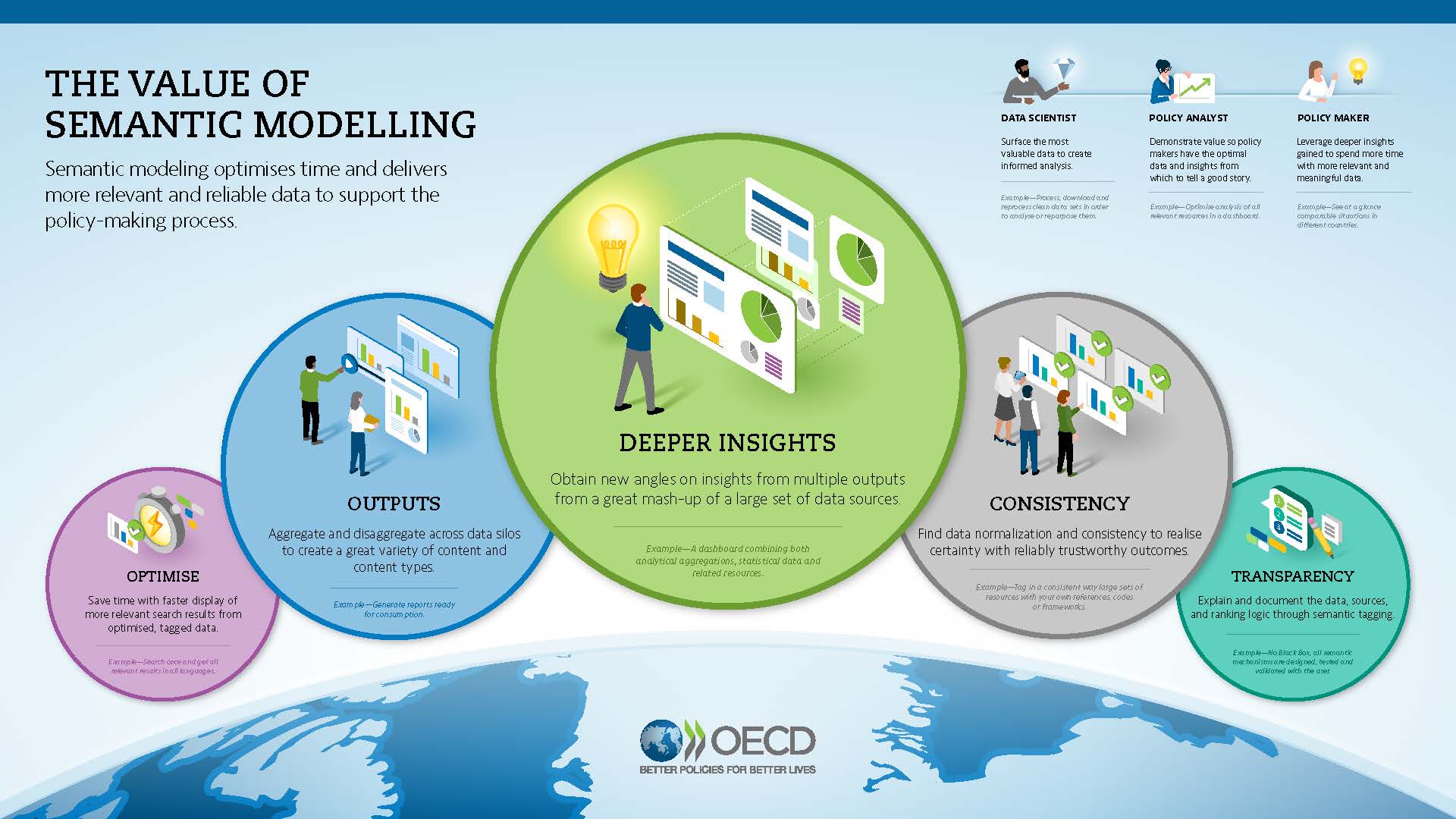
The final deliverable was not a traditional findings document. Territory developed an illustrated map of the full semantic data landscape at the OECD: the people involved, the value created at each step, the audiences being served, and the opportunities for growth. Alongside it, a companion visual on the value of semantic modeling broke down the benefits so they could land with a policy analyst, a data scientist, or a policymaker. DKI’s challenge was not a shortage of information. It was a communication problem. A report would have sat on a shared drive. The map could travel.
Building momentum from here
Territory’s recommendations gave DKI a clear path: design communications that build understanding of what semantic data is and why it matters, lead with low-effort value propositions that give teams a tangible first win, promote success stories as often as possible, and continue refining the implementation process so teams know what they are signing up for. The semantic model was never going to sell itself. But with clearer stories, sharper artifacts, and a realistic account of what implementation requires, DKI left the engagement with a foundation they could build on.
Explore more